
Activist Style
How to Become an Activist: Start Where You Are
Find a cause, listen to your community, and choose a first action you can keep doing. A practical guide to everyday activism.

You become an activist by taking part in work for a change you care about. That may mean a public demonstration, a letter to a representative, a volunteer shift, or careful support for a community-led campaign. You do not need an audience, a special title, or the ability to attend every event.
The hard part is often choosing where to begin. A feed full of urgent problems can make every task feel too small and every issue feel equally pressing. A useful starting point is one concern, one concrete request, and one action you can complete. This guide helps you build that plan in a U.S. civic context without pretending there is one correct way to participate.
Start with Clothing Justice's Action Desk and free resources if you want a place to explore. Then use the steps below to check an opportunity, choose your role, and make your first contribution. You can adapt the pace to your health, work, caregiving, money, and personal circumstances.
1. Pick one issue and name a practical change
Start with a concern you can describe without repeating someone else's slogan. What feels wrong? Who experiences the problem? What would improve their situation? Write a short answer to each question. You are building a working starting point, not announcing a finished understanding of the whole issue.
Separate a broad value from a specific request. “Everyone deserves access” is a value. “Ask the library board to publish an accessible meeting schedule” is a possible request. That example is hypothetical and would need checking against a real community's needs. The useful habit is moving from a general concern to a decision someone can make.
Choose a scope that fits your starting point. You might begin with a workplace procedure, a school meeting, or a neighborhood service rather than a national campaign. A smaller scope does not make the concern less worthy. It can make the people involved, the process, and the next step easier to understand.
Keep room to revise your first idea. Learning that the community wants a different change is progress, not a personal failure. Our mission makes space for learning and questions because civic participation should grow from understanding, not pressure to sound certain.
2. Learn from people affected and check the evidence
Look for community-led organizations, public testimony, local reporting, and original documents that explain the issue. Listen to people directly affected without expecting them to teach you on demand or share private experiences. Read what they have chosen to make public before sending questions they have already answered.
Make a simple evidence note with four parts: the claim, the source, the date, and what remains uncertain. A proposal, a vote, a law, and an implemented policy are different stages. Do not describe one as another. Check whether a document concerns your city or a different place, and whether a headline describes a final decision or something still under discussion.
For unfamiliar words, use our civic lexicon as a starting point, then read the relevant original document. If a campaign cites a report, follow the link to the report itself. Check what the researchers counted and which people or period the findings describe. A memorable number can lose its meaning when its context disappears.
Keep two or three reliable sources in your notes instead of collecting dozens of screenshots. Record the exact section that supports a claim. If you later share the information, your reader should be able to find the same evidence. When you cannot verify a statement, leave it out or state clearly that it is unconfirmed.
You do not need to know everything before helping. You do need to distinguish what you know from what you assume. That habit protects the trust of people who may rely on your message.
3. Find out who can make the change
Before choosing a tactic, identify the person or body with authority over the request. A city council, school board, state agency, business owner, or federal representative may control different parts of an issue. Ask an established organizer how the decision works if the route is unclear.
USAGov's elected-official directory provides routes to federal, state, and local representatives and their contact information. Use it to find the appropriate office, then read that office's current website. Confirm jurisdiction and the actual meeting, proposal, or process before asking someone to act.
For a hypothetical transit issue, a request about a bus stop may belong with a transit authority or local transport department rather than your senator. A campaign can involve several levels, but your first message should make clear which decision you want this recipient to make. Sending a broad complaint to the wrong office can leave you waiting without a useful reply.
Write your plan as a sentence: “I want [decision-maker] to [specific action], and my next task is [something I can complete].” If you cannot fill the blanks yet, make finding that information your first task. Research counts when it answers a question the campaign actually needs resolved.
4. Join existing work and ask what is needed
Look for a group already doing the work before starting a new organization. Find a current public event, volunteer page, local chapter, or contact address. Read the group's stated aims and recent updates. Check whether its activities and approach match your values and whether the people affected have a real voice in its decisions.
Ask a specific question. “I can help for an hour on Saturday and I am comfortable proofreading. Is there a current task I could take?” gives an organizer something useful to answer. “Tell me how to fix everything” does not. Describe your actual availability and skills without promising more than you can deliver.
Check an opportunity before signing up. Look for a named host, current date, clear location or access instructions, and a way to contact the organizer. An old event flyer can circulate long after its date. Visit the group's own announcement rather than relying only on a repost. Our Action Desk is a starting point for finding organizer-led participation, not a substitute for confirming the current details.
At your first meeting, listen for the group's immediate need and how work is assigned. Ask who will review your contribution, where to send it, and when it is due. Respect internal boundaries and requests about confidentiality. Being dependable on a small task helps a group decide where you can contribute next.
5. Choose a role that fits your real capacity
Activism needs more than speeches and signs. Depending on what a group requests, you may be able to proofread a newsletter, welcome attendees, prepare materials, take approved notes, research a public agenda, or help organize a shared calendar. Offer a skill you have, and ask whether it solves a present need.
Give yourself a realistic time budget. Choose a task you can complete during the week you actually have, including travel and preparation. A short, clearly defined contribution is easier to sustain than a vague promise to be available all the time. Tell the coordinator early if your circumstances change.
If you cannot attend in person, ask about remote tasks or another form of support. Do not assume an online role is automatically easy or accessible. Check the tools, deadlines, reading load, and meeting times. A useful role should fit your circumstances as well as the group's needs.
You can start with everyday participation too. The Rally of 1 recognizes that public life includes conversations, learning, and small acts of support between larger events. That does not mean every purchase or post is a campaign achievement. It means you can connect an ordinary action to a clear purpose and a real next step.
6. Use civic channels with a specific request
A message to a representative is easier to assess when it identifies the issue, explains your connection, and asks for an action. Use the official contact route, follow any required fields, and keep the main request near the beginning. Include a relevant bill or agenda item only after checking its exact identifier.
A draft might say: “I live in your district. I am writing about [verified proposal]. Please [specific request]. This matters to me because [brief personal explanation]. Please tell me your position and the next decision date.” This is a template to adapt, not a claim that a particular office must respond or that one message will change a vote.
Public comments offer another route. The EPA's guide to participating in rulemaking explains that people can comment on proposed regulations through the relevant public process. Check the actual agency notice for the deadline, submission method, and requested information. Local hearings and other agencies may use different procedures.
When commenting, explain the relevant concern in your own words and connect it to the proposal. Keep evidence and personal experience distinct. Before submitting, check whether the process publishes comments and personal information. Leave out sensitive details that are unnecessary to make your point.
If you are eligible to vote, USAGov's registration guide directs people to state-specific registration options and requirements. Check your state's current deadline and eligibility rules through its official election authority. Voting can be one part of a wider participation plan, alongside the work between elections.
7. Prepare before attending a demonstration
Confirm the organizer, purpose, location, and current instructions. Ask about accessibility and the role you are being invited to take. Know your route home and discuss a meeting point with anyone attending with you. Decide what you are comfortable doing before you arrive rather than relying on pressure in the moment.
The ACLU's Protesters' Rights overview describes First Amendment protection for protest and the possibility of narrow government restrictions. Review current guidance for your location. This article and our Pocket Rights resource are general education, not personal legal advice. Consult a qualified lawyer for questions about your situation.
Think through personal privacy before posting photos or collecting information. The Electronic Frontier Foundation's protest guide explains that security needs differ by person and event and recommends considering consent before sharing identifiable images. Avoid assuming that every participant wants to appear in your public post.
If you want a sign, our guide to making a protest sign covers a clear message, readable lettering, and checking event rules. You can participate without a sign. You can also choose another role if a demonstration does not suit your health, responsibilities, or personal risk.
8. Track the contribution and follow up
After your first task, note what you completed, who received it, and what happens next. Keep the record factual. “Sent a comment before the deadline” is a completed action. “Changed the policy” needs evidence of an actual decision and should not be credited to you without support.
Ask the coordinator whether your contribution was useful and whether anything needs correcting. If you made an error in a shared document or public post, correct it clearly. Protecting a campaign's credibility matters more than defending every sentence you wrote.
Set one follow-up date. That might be the next meeting, a scheduled reply to the organizer, or a check of the published decision. Avoid refreshing the news constantly when there is no new information to act on. A repeatable task and a defined review point give your effort a rhythm.
Leave useful notes for the next person. Record the source, contact route, deadline, and status of the task without sharing private information unnecessarily. Work that another volunteer can understand and continue is often more helpful than a dramatic action nobody can repeat.
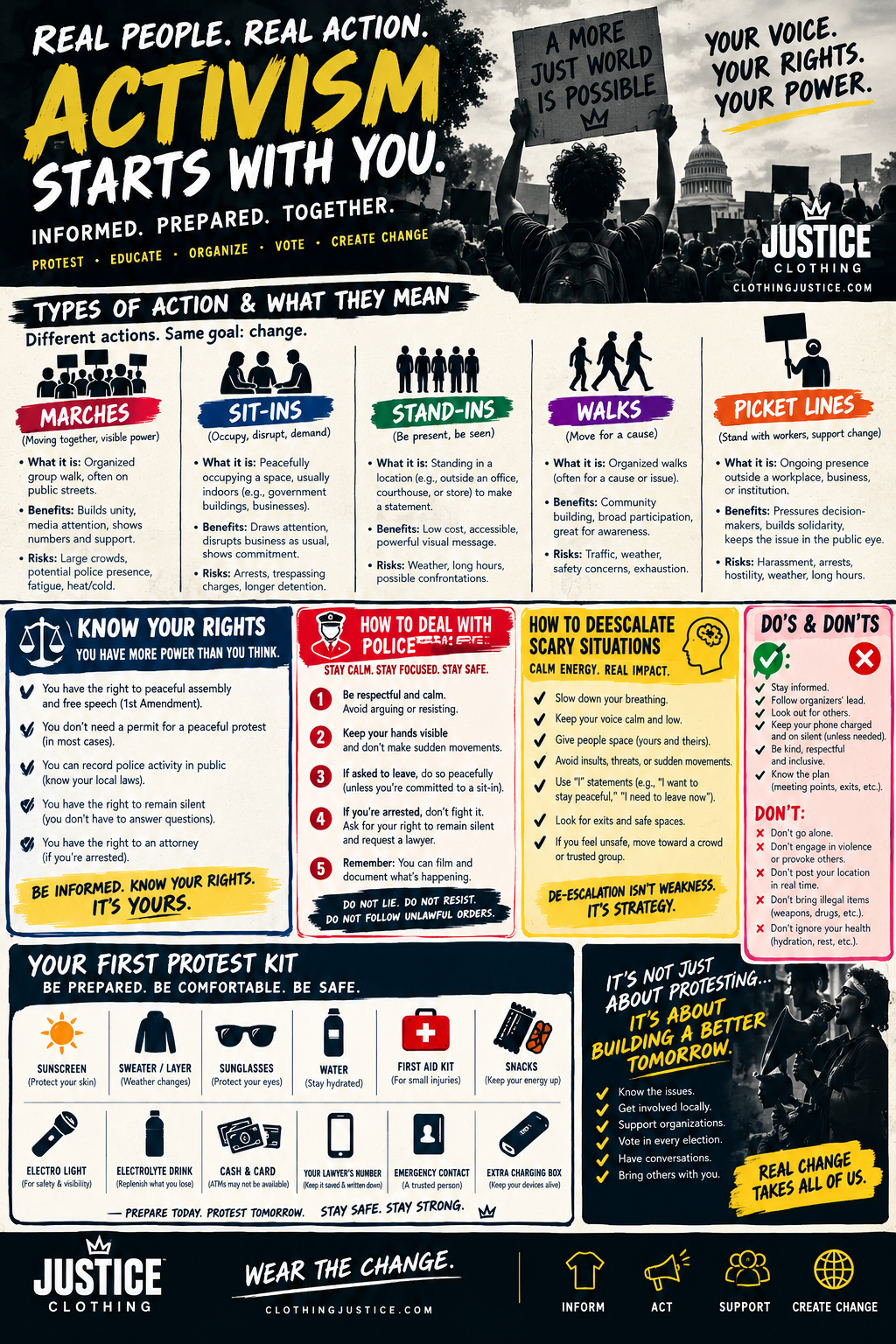
Our Activism Starts With You poster companion connects creative encouragement with practical participation. Use the artwork as a prompt, then check current sources for factual and legal information. The Activism Is a Power companion offers another way to reflect on what public participation can mean.
9. Make a first-month plan you can sustain
Use the first week to choose an issue, read a few reliable sources, and identify a group or decision-maker. In the second week, attend an introductory meeting or contact the organizer about a specific task. In the third, complete that task. In the fourth, ask for feedback and decide what you can repeat.
This is a suggested pace, not a deadline. You may need longer, and you may discover that a different issue or group fits better. Keep your commitments small enough that you can finish them without neglecting essential responsibilities. Tell collaborators when you need a break so they can plan around your availability.
Measure your starting progress by things you can verify: a useful question answered, a completed task delivered, a source checked, or a next meeting confirmed. No guide can promise a political result in a month. You can build a clearer understanding and a reliable contribution in that time.
Your starting checklist is simple: one issue, one checked request, the right decision-maker, a group or channel you have verified, a task that fits your capacity, and a follow-up date. Keep it somewhere you will see it before taking on another commitment.
Keep your values visible with Clothing Justice
Clothing Justice connects civic learning with everyday expression. Our Who Gets a Say? T-shirt and Personalize My Rally of 1 zip-up hoodie are optional ways to carry a message into ordinary conversations. Choose apparel because it feels true to you, then pair that expression with the action you have planned. You do not have to buy anything to use our guides or begin participating.
Frequently asked questions
How can I become an activist with no experience?
Choose one issue, learn from reliable sources and people directly affected, then ask an existing group for a small, specific task. Complete it, ask for feedback, and agree on a follow-up. You can develop your understanding while making a useful contribution.
Do I have to attend protests to be an activist?
No. Depending on a campaign’s needs, participation can include research, proofreading, contacting representatives, public comments, meeting support, and other volunteer work. Choose a role that fits your capacity and serves a clear request.
Can I be an activist if I work full time?
Yes. Offer a realistic amount of time and ask for a defined task with a clear deadline. Include preparation and travel in your time budget, and tell the coordinator early if your availability changes.
How do I check whether an activism opportunity is current?
Find the organizer’s own announcement and confirm the host, date, location or access details, and contact route. Read the group’s recent work and stated aims before signing up. Do not rely only on a reposted flyer or an undated social post.
Related posts

Activist Style
Activism Isn’t Just About What You Stand For. It’s About How You Stand for It.
A guide to handling disagreement, protecting your peace, keeping yourself safe, and remembering why you started in the first place.
Read the guide →
Activist Style
How to Make a Protest Sign That People Can Read
Choose a clear message, check your facts, and make a readable protest sign with simple materials and a practical plan.
Read the guide →
Activist Style
What Is Activist Clothing? A Guide to Wearing Your Values
A practical guide to choosing message-driven clothing, wearing it with care, and letting it lead to action.
Read the guide →Activist Style
Activist Outfit Guide: What to Wear and Bring
A practical guide to putting together an activist outfit that is comfortable, considered, and ready for the day ahead.
Read the guide →
Activist Style
Activist Clothing Brands: What to Look For Before You Buy
A practical guide to choosing message-driven clothing that feels honest, wears well, and supports the values you want to carry.
Read the guide →
Activist Style
Protest Fashion: Wearing a Message With Care
A practical guide to the history, choices, and follow-through that give protest fashion real staying power.
Read the guide →
Activist Style
Political T-Shirts: Choose a Message You’ll Wear
A practical guide to choosing a political T-shirt with care, context, and a message that fits your everyday life.
Read the guide →